

A letter to our fellow resident doctors
Please note that the following letter represents the views of some CMF members, not of CMF itself. We have explored this issue in our blogs, publications, and in online seminars over many years, and recognise our members hold a range of views on taking industrial action and the current dispute.
Dear Fellow Resident Doctors,
We know that many of you will be thinking about how to respond to the most recent government proposals and BMA poll, to bring to an end the forthcoming resident doctor strikes in England[1].
The resident doctor strikes in England have evoked a number of responses and emotions from people on both sides of the debate. We recognise that some will have felt this is the best way to seek justice for generations to come, others will have concerns about workforce planning and training posts, still others will have felt it best to not take strike action. Whatever your position, and acknowledging ours have also changed, we write to you now as your fellow RDs, and a brother and sister in Christ, with a call to reflect and pray about the issues at hand and how to respond as Christ would have us, remembering that whatever we do, we do as onto the Lord (Col 3:23-24).
We write with our own perspectives, having participated in previous strikes. Our perceptions have changed with the current mandate. Whilst we understand and respect each doctor, and generation of doctors will have their own situation, we will be balloting to accept the government’s new offer, but welcome discussion and other perspectives.
We do hope that as you read you will be encouraged and reminded of the great privilege we have to serve Christ and our patients in medicine, and that the love for Christ and neighbour (Matthew 22: 37-39) would be our guiding principle as we consider our response to this new poll.
How did we get here?
The current resident doctors disputes in England begun in 2023, in a bid to achieve pay restoration following a real terms pay decrease since 2008. Many of you will know that the BMA was, and continues to ask for 35% pay uplift, bringing pay back in line with what it would be in 2008 – using the Retail Price Index (see footnote.)[2]. This original ballot, and subsequent ballots have received support in favour of industrial action to achieve this aim. This has continued even with a change of government, who within weeks of coming into office, offered resident doctors a credible deal which was accepted by the membership in 2024 [3]. But aside from all the figures, what else lies at the heart of the issues? Anecdotally, for many doctors, pay factors into a much larger argument on working conditions, wellbeing, worth, and value. Furthermore, in the most recent industrial action, the very real issue of training posts, and lack of job security has been brought to the fore[4].
And even whilst some may question whether striking is the right thing to do, it is important to recognise that resident doctors working in 2025 face different challenges to previous generations, with significantly higher student debt[5], greater job insecurity, and higher competition ratios for specialty training [6]. These issues weigh heavily on the hearts and minds of not only doctors but also medical students soon to join the profession, and sadly do not always get reflected in the wider narrative on strikes.
Why is this a good time to take stock and reconsider further strike action?
The current round of strikes has led to demonstrable change with improvements to resident doctors salaries, though these are still between 4% and 10% less than 2010-11, the metric used by Nuffield Trust[7]. Whilst greater public awareness of the challenges resident doctors face is welcomed, the proposed strike amidst the current flu outbreak, and with it being so close to Christmas, may only undermine the important work being done in the NHS to deliver frontline care, and potentially erode confidence in the medical profession.
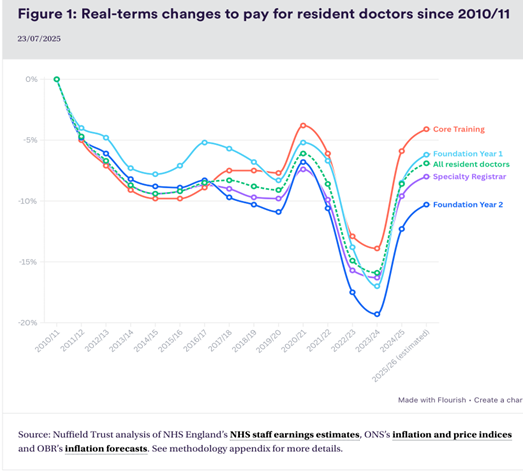
Figure 1[8]
In the current climate, it would seem that the industrial action is not merely seeking to improve doctor’s working lives, but also cause maximal disruption for the very patients we seek to serve, and the colleagues left to cover the clinical workload. Whether it’s cancelled appointments, operations, or just the considerable strain on our consultant colleagues, who are similarly under pressures despite better pay.
It is important to remember that there are many facing far worse financial hardship than resident doctors, and at time when the nation as a whole is feeling the pinch, to us it seems insensitive to expect the government to promise full restoration.
My reflections from the 2015-16 strikes
Whilst specifics of the mandate between 2016 and the imposition from the government are quite different to this current situation, I wanted to share my experience and personal reflections from the time which may have some parallels to how some resident doctors feel today.
Washing up on the shores of foundation training in August 2015, I was looking forward to do the job I’d trained for, anxious about making mistakes, and excited about my first pay check. That pay packet arrived, bulging because of unmet tax threshold and was a balm like aloe vera on sunburn. My first days of being a doctor were a heady mix of adrenaline, cortisol and dopamine; I was high on being able to serve patients with a smile, a newfound emerging authority, colleague camaraderie, and being trained by bosses whom I respected. I was grateful to God that I could embark on this adventure while earning a good salary.
Unfortunately, the comedown from my high was swift. August quickly transitioning to a winter of discontent; there were BMA rumblings of strikes, and colleague grumblings about our conditions and pay[9] compared with friends in other professional jobs. When the health secretary at the time questioned our vocation, we were insulted. We had been naively trapped into a profession out of our goodwill, oppressed by our employer, misunderstood by the population we served, and victims of a broken system that served everyone but us.
I picketed with my colleagues during the strikes and handed out BMA leaflets on the streets. Ward rounds dragged a bit longer, every minute of working past paid hours felt a little like a personal insult. Work went from a privilege to a chore. I had allowed bitterness to affect my work ethic and to steal my love and joy for serving patients. I had forgotten how my pay even then (including on call and evening work) was a little higher than the median salary across the nation. I had forgotten how privileged I was to have my health in a hospital full of people without it, and ultimately I had forgotten my gratitude and servitude to God.
The ongoing fight to contend for joy
Whilst these are my reflections from a decade ago, the need to contend for joy in a fallen world is no less relevant. My career has had some ups and downs, and I’ve had to slowly flush out that bitterness which has affected my attitudes and possibly even my progression. I have had to repent of bitterness and also selfishness. For me, seeing healthcare staff joyfully embracing their work with significantly worse pay and conditions in brief stints working as a doctor in sub-Saharan Africa, and having a wife (also a doctor) who happily gives her all in work while blissfully unconcerned by money and politics helped me change my perspective. How might our working lives look different if we chose to contend for joy as Christian doctors?
Negative discussions with colleagues (both junior and senior) have not gone away, our conversations are saturated with unhappiness over pay and conditions, with dreams of emigrating or working in other sectors. Rather than letting resentment poison our outlook, we can give ourselves the antidote; worshiping the God who laid down his life for us, ‘Even as the Son of Man came not to be served, but to serve, and to give his life as a ransom for many.’ (Matthew 20:28) Additionally, while striking over pay can be about justice and a genuine need for provision, we also fear that it is easy to be swept up into arguments which prize wealth, lifestyle, and status over the sacrificial heart which Jesus calls us to. An excellent CMF article has been written already on this subject[10].
How can we be salt and light as Christ’s representatives in our workplace?
Firstly, we need to pray; bringing our leaders, colleagues and patients to God at a time when the NHS is on its’ knees. Secondly, we need to consider the roles Christians can play in mediating a peaceful and constructive outcome to the current (and indeed any future) industrial action that benefits all the stakeholders and most importantly our patients, in keeping with our call to ‘seek the good of the city’. (Jeremiah 29:1-11). Lastly, we need to pray for Christians to rise up and lead in their NHS workplaces, trade unions, and higher levels of NHS management, to shape the organisation and its values to align with those which reflect the heart of Christ for human flourishing.
As a couple of more seasoned resident doctors, we acknowledge our personal biases, and we can’t prescribe balloting one way or the other, rather we appeal to each of us to guard our hearts against bitterness, and the love of money [11] to serve our patients, colleagues and earthly masters with love, ‘as working for the Lord, not for human masters.’ (Colossians 3:23).
‘I’ve been young, and now am old, but I’ve never seen the righteous forsaken, or his children beg for bread.’ Psalm 37:25
In Christ,
Much has been written by colleagues at CMF about the current and previous strikes, which we would commend to you for further reading [12], [13]
Footnote:
The BMA chooses to use the RPI (retail price index) measure of inflation, which is felt by many experts to overestimate inflation and therefore inflate the real-terms losses in doctor pay. The BMA rightly points out that RPI is used to calculate student loan interest, and that it also accounts for house prices and the cost of mortgage interest payments, not included in the CPI (Consumer Price Index) favoured by the government when considering inflation in pay disputes. According to the officer of Public Statistics from the Royal Statistical Society, it is likely that true inflation in practical terms for UK households lies between these two measures. https://www.ft.com/content/f4e62ed9-53a4-4f6c-b901-20e710ff7110.)
References
[1] https://www.gov.uk/government/news/government-to-prioritise-uk-medical-graduates-for-training-places
[2] https://www.bma.org.uk/our-campaigns/resident-doctor-campaigns/pay-in-england/pay-restoration-for-resident-doctors-in-england
[3] https://www.bma.org.uk/our-campaigns/resident-doctor-campaigns/pay-in-england/2024-pay-deal-for-resident-doctors-working-in-england
[4] https://www.bma.org.uk/our-campaigns/resident-doctor-campaigns/pay-in-england/specialty-training-places-crisis-in-england
[5] https://inews.co.uk/inews-lifestyle/money/thousands-doctors-face-student-loans-never-clear-3901646?srsltid=AfmBOorNmPW8QXvnmb8sq_w0iohMhey2VjRRbsZlXDkEGGf6H7xNfsHu
[6] https://www.bma.org.uk/news-and-opinion/major-survey-shows-scale-of-doctor-unemployment-crisis
[7] https://www.nuffieldtrust.org.uk/resource/exploring-the-earnings-of-nhs-doctors-in-england-2025-update
[8] Figure taken from Palmer W and Rolewicz L (2025) “Exploring the earnings of NHS doctors in England (2025 update)”. Explainer, Nuffield Trust. Accessed 12 December 2025
[9]https://www.ons.gov.uk/employmentandlabourmarket/peopleinwork/earningsandworkinghours/bulletins/annualsurveyofhoursandearnings/2016provisionalresults
[10] https://www.cmf.org.uk/because-youre-worth-it-the-bma-and-the-junior-doctors-strikes/
[11] Matthew 6:21;24
[12] https://www.cmf.org.uk/because-youre-worth-it-the-bma-and-the-junior-doctors-strikes/
[13] https://www.cmf.org.uk/article/the-junior-doctors-strikes/