

• Log In
  • Join
  • Shop
  • Donate
The Christian Medical Fellowship: Uniting & equipping Christian doctors & nurses to live & speak for Jesus Christ.
  • 0Shopping Cart
Christian Medical Fellowship
  • About
    • About
      • the Christian Medical Fellowship unites and equips Christian doctors and nurses to live and speak for Jesus Christ. We were formed in 1949. We currently have 4,000 doctors, 500 medical and nursing students, and 450 nurses and midwives as members.
      • Who we are

        find out about us and contact the team
        • heritage
        • staff
        • trustees
        • vacancies
      • What we do

        • aims
        • what we do
        • frequently asked questions
      • What we believe

        the core beliefs and values behind CMF, and who we associate and work with
        • statement of faith
        • affiliations
  • News
    • Latest News
      • what we are writing about
        • Blogs
      • person writing a letter

        A letter to our fellow resident doctors

        December 12, 2025
        Read more
        https://www.cmf.org.uk/wp-content/uploads/2025/12/Dear-fellow-Residents.-1.png 1440 2560 christianmf https://www.cmf.org.uk/wp-content/uploads/2023/08/CMF-Logo-MONO-TRANSPARENT-340px.png christianmf2025-12-12 17:55:582025-12-13 18:23:30A letter to our fellow resident doctors

        the trouble with opt-outs

        December 1, 2025
        Read more
        https://www.cmf.org.uk/wp-content/uploads/2023/08/organ-donation.jpg 240 400 Trevor Stammers https://www.cmf.org.uk/wp-content/uploads/2023/08/CMF-Logo-MONO-TRANSPARENT-340px.png Trevor Stammers2025-12-01 08:00:492025-11-27 13:23:42the trouble with opt-outs

        Three-parent embryos: can the end ever justify the means?

        August 12, 2025
        Read more
        https://www.cmf.org.uk/wp-content/uploads/2025/08/AdobeStock_1252305052-scaled.jpeg 1440 2560 Dr Rick Thomas https://www.cmf.org.uk/wp-content/uploads/2023/08/CMF-Logo-MONO-TRANSPARENT-340px.png Dr Rick Thomas2025-08-12 08:00:412025-08-08 10:29:05Three-parent embryos: can the end ever justify the means?
  • Events
    • Latest Events
      • book in for CMF conferences, training days, and other events for Christians in the healing and caring professions
      • Current Month

        Date

        Event Type

        All

        Doctors

        Global

        Junior Doctors

        Nurses & Midwives

        Students

        10jan10:00 am4:30 pmRASH: Refugee and Asylum Seeker Health Course, London

        Event Details

        God calls us to care for the stranger in our midst, to protect orphans and widows,

        Event Details

        God calls us to care for the stranger in our midst, to protect orphans and widows, to ‘act justly and love mercy’ . (Micah 6:8) How does this translate to the way we care today?

        Given the proposed changes to the way that our asylum system works, how can we provide the best possible healthcare to those in need?

        The ‘Refugees and Asylum Seekers Health Course’ (RASH) aims to equip Christian healthcare practitioners and others to:

        • Improve knowledge of the healthcare needs, responses and challenges for refugees and asylum seekers in the UK
        • Hear examples of good practice
        • Foster a dialogue among those working with refugees and asylum seekers for mutual encouragement and support
        • Inspire creative ways to engage with health systems for better provision, support, and care

        View the full programme here.

        The programme is an interactive learning experience led both by those who have been refugees and those who are healthcare professionals in this field. Local charities or churches working with refugees and asylum seekers will also find this day useful. If you encounter people from outside the UK in your everyday practice, then this is the day for you.

        more

        Time

        January 10, 2026 10:00 am - 4:30 pm(GMT+00:00)

        Location

        London

        CalendarGoogleCal

        Yarnfield, Stone ST15 0NLYarnfield Park Training & Conference Centre

        30jan01febStudent Conference 2026

        Event Details

        Select:ID Who are you? It is a fundamental question to answer as you start your journey as a health professional. The world has a lot of answers, you are your

        Event Details

        Select:ID
        Who are you?

        It is a fundamental question to answer as you start your journey as a health professional. The world has a lot of answers, you are your job, your sexuality, your gender, or your racial and national identity. But the gospel of Jesus tells us that we are forgiven, we are chosen, we are beloved, we are made holy, and we are God’s own treasured possession. How do we live out that truth in our everyday life, our studies, and our careers?

        Join us at CMF’s Student Conference – from 30 January to 1 February 2026 (Yarnfield, Staffordshire)

        If you’re a Student, here’s our top tips for booking
        1. Grab a cup of tea, and have a read to choose four seminars you would like to attend, look through your options in our Conference Programme.

        2. Now you’re ready to book onto Student Conference 2026.

        Thanks to generous donations, extra subsidies may be available to help students attend the Student Conference. If any bursary is available, we’ll be in touch — any support will be arranged as a refund after the event.

        For non-Students
        1. If you’re a Medical School Link coming with a group of students, please select the Med School Link Ticket on the booking form
        2. If you have happy memories of your time at Student Conference, and if you would like to invest in the next generation of Christians healthcare professionals please use the donation form:

        more

        Time

        January 30, 2026 5:00 pm - february 1, 2026 3:00 pm(GMT+00:00)

        Location

        Yarnfield, Stone ST15 0NL

        Yarnfield Park Training & Conference Centre

        CalendarGoogleCal

        05mar8:00 pm9:00 pmChristians in Healthcare Leadership Spring Webinar 2026 - How to Raise Concerns

        Event Details

        Open to all CMF Members 8 – 8.05. Introduction 8.05 – 8.15 Loving the individual, but hating the sin: Lessons from the woman at the well 8.15 – 8.30 Raising concerns: Avoiding the negative

        Event Details

        Open to all CMF Members

        8 – 8.05. Introduction

        8.05 – 8.15 Loving the individual, but hating the sin: Lessons from the woman at the well

        8.15 – 8.30 Raising concerns: Avoiding the negative and positively influencing culture

        8.30 – 8.45 Counting the cost: Institutional whistle blowing & Dealing with lack of insight

        8.45 – 9.00 Discussion and prayer

        Registration now, you will receive the Zoom details nearer to the event. 


        more

        Time

        March 5, 2026 8:00 pm - 9:00 pm(GMT+00:00)

        CalendarGoogleCal

        Yarnfield, Stone ST15 0NLYarnfield Park Training & Conference Centre

        07may(may 7)3:30 pm08(may 8)5:00 pmNAMfest 2026Dressed in Christ and ready for work

        Event Details

        Dressed in Christ, ready for work Thursday 7 - Friday 8 May 2026, Yarnfield Park Training & Conference Centre, Staffordshire, 

        Event Details

        Dressed in Christ, ready for work

        Thursday 7 – Friday 8 May 2026,

        Yarnfield Park Training & Conference Centre, Staffordshire, ST15 0NL

        Bookings go live in January, watch this space…

        The Nurses and Midwives team can’t wait to see you at NAMfest 2026


        more

        Time

        May 7, 2026 3:30 pm - may 8, 2026 5:00 pm(GMT+00:00)

        Location

        Yarnfield, Stone ST15 0NL

        Yarnfield Park Training & Conference Centre

        CalendarGoogleCal

      • See all events
  • Ministries
    • Ministries
      • the heart and soul of the fellowship
        • senior doctors and retirees
        • resident doctors
        • students
        • nurses & midwives
        • global
        • ethics, advocacy & public policy
        • volunteering & training
        • pastoral
        • member services
        • other
  • Resources
    • Resources
      • CMF's resources are there for Christians working or studying in the health professions, as well as for churches and Christians in general
        • publications
        • bookstore
        • blogs
        • subject archive
        • podcasts
        • global resources
        • prayer resources
      • https://www.cmf.org.uk/wp-content/uploads/2025/10/Cover.png 503 359 Steve Fouch https://www.cmf.org.uk/wp-content/uploads/2023/08/CMF-Logo-MONO-TRANSPARENT-340px.png Steve Fouch2025-10-17 14:46:542025-11-06 20:06:28Triple Helix – autumn 2025
        https://www.cmf.org.uk/wp-content/uploads/2024/09/Freshers-Nucleus.png 610 424 Steve Fouch https://www.cmf.org.uk/wp-content/uploads/2023/08/CMF-Logo-MONO-TRANSPARENT-340px.png Steve Fouch2025-09-05 14:54:582025-09-05 14:54:58Freshers’ Nucleus 2025
        spotlight winter 2025
        https://www.cmf.org.uk/wp-content/uploads/2025/12/featured-spotlight-winter-25-image.png 737 733 christianmf https://www.cmf.org.uk/wp-content/uploads/2023/08/CMF-Logo-MONO-TRANSPARENT-340px.png christianmf2025-12-15 18:16:442025-12-15 18:16:44spotlight | winter 2026
        https://www.cmf.org.uk/wp-content/uploads/2025/11/CMFFile78Thumbnail.png 1056 752 christianmf https://www.cmf.org.uk/wp-content/uploads/2023/08/CMF-Logo-MONO-TRANSPARENT-340px.png christianmf2025-11-03 13:58:142025-11-06 20:48:28CMF file 78 – ethics: a matter of principle
        prayer diary dec to march 26 thumbnail
        https://www.cmf.org.uk/wp-content/uploads/2025/12/prayer-diary-dec-to-march-26-thumbnail.png 373 258 christianmf https://www.cmf.org.uk/wp-content/uploads/2023/08/CMF-Logo-MONO-TRANSPARENT-340px.png christianmf2025-12-01 13:30:392025-12-01 13:30:39Prayer Diary | December 2025-March 2026
  • Contact
    • Contact Us
      • We aim to reply as quickly as possible. If you want us to telephone, please include a phone number in your email text.
      • Member services

        for any communications and questions about CMF membership
        • member services ministry page
        • financial queries
        • frequently asked questions
        • privacy policy
        • safeguarding policy
        • legal and copyright
      • Room hire

        looking for a meeting place in London? Our meeting rooms are available in central London
        • conference and meeting rooms
      • Get in Touch

        • contact CMF
  • Search
  • Menu Menu
  • About
    • Who We Are
      • Our Heritage
      • CMF Staff Team
      • Trustees
      • Vacancies at CMF
    • What We Do
      • our aims
      • What We Do
      • Frequently asked questions
    • What We Believe
      • Statement of faith
      • Affiliations
  • News
  • Events
  • Ministries
    • Seniors
    • Residents
    • Students
    • Nurses & midwives
    • Global
    • Ethics, Advocacy & Public Policy
    • Volunteering & training
    • Pastoral
    • Member services
    • Other ministries
  • Resources
    • Publications
    • Bookstore
    • Blog
    • Student Archives
    • Podcasts
    • Global Resources
    • Prayer Resources
  • Contact
    • Members Services
      • Member services
      • Privacy Policy
      • Safeguarding Policy
      • legal matters
    • Room Hire
    • Get in touch

Abortion – a quick guide for teachers

To support the teaching of Relationships and Sex Education in secondary schools

Purpose of this factsheet

This factsheet is to assist teachers in schools and colleges teaching about abortion as part of Relationships and Sex Education. Abortion is a sensitive issue that should be approached carefully with students, in a factual yet caring manner. Young people need to be educated about all the options open to them in situations of pregnancy. This should include ethical and medical perspectives about unborn life and the potential physical, emotional, and mental consequences of abortion.

It is vital to remember that any student in your lesson could have been affected by abortion – a family member, a friend, or directly themselves. They could also be affected by miscarriage or stillbirth, which are obviously traumatic. The language you use really matters!

Key terms

  1. Fertilisation: the point when the sperm and egg fuse.
  2. Zygote: the first stage of a new organism. A single cell structure, formed from the union of sperm and egg that will then divide to form an embryo.
  3. Embryo: ‘an unborn human, especially in the first eight weeks from conception, after implantation but before all the organs are developed.’ [1]
  4. Fetus/Foetus: ‘an unborn human more than eight weeks after conception.’ [2]
  5. Viability: the point at which a child is capable of life outside the womb.
  6. Pro-life: a term to describe people who believe that because the embryo/fetus is a separate human from its earliest stages, it deserves a high level of care and protection.
  7. Pro-choice: a term to describe people who believe that the pregnant woman ought to be able to choose whether to keep or end her pregnancy.

What is the abortion debate about?

Abortion is the deliberate ending of a human life before birth. Pro-life sources tend to prefer to call this human an ‘unborn baby’, while pro-choice sources tend to use the terms ’embryo’ or ‘fetus’. All these terms are accurate, but one is informal, while the others are technical. The terms are interchangeable but politically loaded. Although using one or another in the lesson doesn’t imply the promotion of either view, it could be good to use a mixture of the terms in a lesson.

Since 1967, when the law changed in Britain (2019 in Northern Ireland) to permit abortions in certain circumstances, there have been over 10 million abortions in England, Scotland, and Wales.[3] Today, around one in four pregnancies in the UK end in abortion.[4]

The abortion debate in the UK is based upon competing values and claims, about which people on either side of the argument often feel very passionate. On one side is the right to life of the unborn; on the other is the woman’s right to bodily autonomy. It is important to remember that most of your students will be ‘somewhere in between’, where they will agree with abortion in the extreme and rare situations often cited – such as rape or incest or where the mother’s life is in danger – but not with abortion being used as an alternative or back-up to contraception. There is also a (decreasing) memory of the time before 1967, when many women died or became seriously ill having had a ‘back-street’ abortion. Those who intended good at the time wanted to bring a halt to women dying because they did not feel able to continue with a pregnancy.

People who are ‘pro-life‘ tend to argue that all human beings are equal, and therefore we have to give unborn children the same legal protection as born children. They hold that factors such as dependency on a mother, size, level of development, or environment do not negate the unborn’s fundamental human rights. They also point out that abortion can be harmful to women; for example, some studies suggest that it can increase mental health risks in some women.[5]

People who are ‘pro-choice‘ usually argue that, at least at the earliest stages of development, the fetus has no (or lesser) moral value, and therefore women should be entitled to make autonomous decisions about whether they want to keep or destroy it.

Some people on either side tend to see the rights of the child or the mother as absolute, whereas others tend to balance competing rights in varying ways.

It is important to consider the perspective of the father in all this, too. Legally, the decision to abort rests with the mother and her medical team (as long as it is within the legal framework). But she is not the only person affected. Support from the father can be very significant in a woman’s choice about whether to terminate a pregnancy. It is also important to remember the reality of reproductive coercion – this can go both ways: either coercion to become pregnant or to have an abortion. This could be something that the students also feel very strongly about, depending on where they are in this debate.

When does human life begin?

More than 95 per cent of biologists agree that human life begins at fertilisation[6] when the genetic material from the sperm and egg fuse. At this point, the zygote has its own genetic code and is a separate human life from that of either its mother or its father. Here are some landmarks of fetal development:

  • At 16-22 days, the heart starts developing.[7]
  • By six weeks (and maybe before), brain waves are detectable.[8]
  • Around ten weeks, there is medical evidence that sensations such as pain begin to be felt.[9]

Pictures and videos of fetuses at different stages of development can be found at https://ehd.org.The survival rates for premature babies have increased significantly as medical care has improved.[10] For example, in 2021, Curtis Means was named by Guinness World Records as the most premature baby ever to survive, having been born at 21 weeks and one day’s gestation.[11]

Why does it matter when human life begins?

Many people believe that there is something uniquely significant about human life compared to other animals. We have national and international agreements on how humans may treat one another. These state that it is not permissible to deliberately end the life of another human. This means that it matters whether the embryo or fetus is to be considered human or not. Most people maintain that the beginning of life is a scientific question and that it is vital to discuss because there are moral obligations associated with human life.[12]

Others hold that the point at which a life becomes morally significant is not clear-cut. They would be more inclined to think that abortion is, therefore, a choice that only the pregnant woman can make.

You may find it helpful to think through some of the following ethical and moral questions:

  • What is it that makes human beings valuable?
  • Are all human beings equal?
  • Should it ever be permissible to end the life of a human being?
  • Should ending the life of an unborn baby be permissible in some situations?
  • Do humans have dignity and value only when they can live independently of other people?
  • Is it morally acceptable to harm an unborn baby through drug or alcohol abuse?

What is abortion?

There are two main types of abortion procedure in the United Kingdom.1. Medical abortion

  • A medical abortion involves the woman taking two drugs. The first, mifepristone, is taken by mouth. After a day or two, mifepristone kills the embryo/fetus, mostly by stopping the supply of nutrients and oxygen through the placenta. The second, misoprostol, is taken up to 48 hours later, either by mouth or as a vaginal tablet. Misoprostol causes the womb (uterus) to expel the embryo/fetus.
  • If the pregnancy has gone beyond 20 weeks or so, the death of the baby is brought about with an injection of potassium chloride. This is recommended for all terminations over 21 weeks.[13] Labour is then induced to expel the fetus.

2. Surgical abortion
There are two methods of surgical abortion:

  • ‘Vacuum aspiration’ (usually up to 14-15 weeks); also known as ‘suction abortion’. This technique involves opening the neck of the womb (the cervix) and using a suction pump to suck out the fetus and placenta, ending life in the process.
  • ‘Dilatation and evacuation’ (usually between 13 and 24 weeks, but also up to birth in some cases). The fetus is too big to be removed using suction, so it must first be pulled apart by forceps and removed in pieces, ending life in the process.

What is the law on abortion?

Abortion is only legal in the following circumstances (given in the Abortion Act 1967,[14] and later amended by the Human Fertilisation and Embryology Act 1990): [15]

a) that the pregnancy has not exceeded its twenty-fourth week and that the continuance of the pregnancy would involve risk, greater than if the pregnancy were terminated, of injury to the physical or mental health of the pregnant woman or any existing children of her family; or

b) that the termination is necessary to prevent grave permanent injury to the physical or mental health of the pregnant woman; or

c) that the continuance of the pregnancy would involve risk to the life of the pregnant woman, greater than if the pregnancy were terminated; or

d) that there is a substantial risk that if the child were born, it would suffer from such physical or mental abnormalities as to be seriously handicapped. [16]

Two medical practitioners must sign off on any abortion on approved premises. Every abortion is recorded (though women can request that the information not be shared with their GP). The form used for this lists the grounds slightly differently from the Act. This is why you may hear about the number of abortions performed under ‘Ground E’ in any given year.
The grounds on these forms are that:

A. The continuance of the pregnancy would involve risk to the life of the pregnant woman greater than if the pregnancy were terminated.

B. The termination is necessary to prevent grave permanent injury to the physical or mental health of the pregnant woman.

C. The pregnancy has NOT exceeded its 24th week and that the continuance of the pregnancy would involve risk, greater than if the pregnancy were terminated, of injury to the physical or mental health of the pregnant woman.

D. The pregnancy has NOT exceeded its 24th week and that the continuance of the pregnancy would involve risk, greater than if the pregnancy were terminated, of injury to the physical or mental health of any existing child(ren) of the family of the pregnant woman.

E. There is a substantial risk that if the child were born, it would suffer from such physical or mental abnormalities as to be seriously handicapped.

EMERGENCY ONLY Termination was immediately necessary:

F. To save the life of the pregnant woman.

G. To prevent grave permanent injury to the physical or mental health of the pregnant woman. [17]

Doctors may refuse to take part in the process of abortion if they feel it is against their conscience to do so, except where it is necessary to save the life or to prevent grave permanent injury to the physical or mental health of a pregnant woman.[18]An ectopic pregnancy occurs outside the womb/uterus and is generally a surgical emergency. It needs surgery to remove it, but this is not considered illegal and does not require any of the documentation for standard termination of pregnancy.

There are over 200,000 abortions in the UK each year. Of these:

  • 98 per cent are performed on mental health grounds (Ground C).

Risks to the mother’s mental health can be interpreted in different ways, ranging from serious conditions, such as schizophrenia, to minor concerns, such as unhappiness or even the fact that the baby is a girl. It is extremely rare for a specific mental disorder to be cited as a reason for the abortion, suggesting that many doctors use the ‘mental health grounds’ as a catch-all clause allowing abortion for various reasons.

  • Around 1.5 per cent of all abortions take place because the unborn child has a disability (Ground E). Although these are supposed to include only serious disabilities, some babies are aborted because of relatively minor conditions like cleft lip. Many are aborted for Down syndrome.
  • Abortions are very rarely performed to save the life of the mother (only a tiny fraction of 1%).[19]

The time limit of 24 weeks’ gestation on some abortions is based on the medical understanding of when the baby is considered likely to be able to survive by itself outside of the womb (viability). However, this limit was set in 1990. The point of viability outside the womb is now considered to be 22 weeks’ gestation, although some babies have survived even earlier.

It is important to remember that most arguments made on both sides (pro-life and pro-choice) are the extremes of the spectrum. Pro-life people usually use examples such as late abortions for Down syndrome or cleft lip, while pro-choice people usually use examples such as rape or when the mother’s life is in danger. The vast majority of abortions fall in the middle. They typically happen earlier in the pregnancy and for social or economic reasons.Legal abortions table2
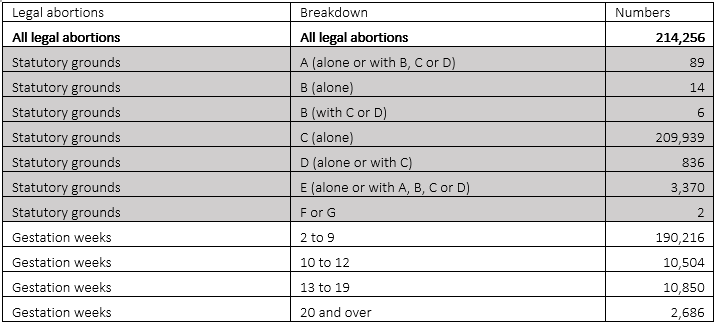
Table 1: Numbers of abortions by statutory grounds and by gestation in 2021. Source: https://gov.uk/government/statistics/abortion-statistics-for-england-and-wales-2021

Students may find it helpful to consider why abortion numbers have continued to rise in recent years, despite the widespread availability of reliable contraception, and what social or economic factors may make an individual woman more or less likely to consider an abortion.

This is where students start having those more mature conversations about right-to-life, consequences of choices, current British culture/society and so on.

What are the consequences of having an abortion?

Physical consequences include:

  • Immediate – pain, bleeding, and potential damage to the womb.
  • Later – the risk of preterm birth in future pregnancies increases the more abortions a woman has.[20] This means the woman may give birth to future babies before they are fully developed, with the risks this causes to the baby’s health and life.

Emotional consequences
Studies show that although many women feel relieved to have an abortion, most women who have an abortion have negative feelings afterwards, often a sense of guilt.[21]

Women who have had abortions, on average, suffer worse mental health issues than women who continue with an unwanted pregnancy, even after taking prior mental health into account.[22]

What alternatives are there in pregnancy?

It should never be a shock to anyone if pregnancy results from sexual intercourse – no contraception is guaranteed to succeed 100 per cent of the time, and some contraceptives have very high failure rates. The best choice a person can make in order not to get pregnant is not to have sex until they are ready to be a parent. Some people wait until they are married before they start a sexual relationship, including many Christians, Jews and Muslims. However, sometimes women find themselves pregnant when it is unplanned – for example when they have suffered sexual abuse or have felt pressured into having sex. This can be an extremely unsettling or upsetting time, and women should always be aware that they can confidentially discuss their situation with their GP or pregnancy crisis counsellors on the telephone or in person.

When women are initially refused an abortion, the large majority keep their baby. Of these, studies show that 96 per cent are later glad that they did not get an abortion.[23]

An alternative to abortion, if someone is unable to look after their baby, is fostering or adoption. The baby will be welcomed into another home where they will be looked after and cared for. There are far more parents hoping to adopt a baby than there are babies available for adoption. Most women who place their child for adoption after an unwanted pregnancy are eventually glad they did so rather than having an abortion.[24]

Where can I find help if I am pregnant?

Many good charities provide help for women to talk through options for keeping their babies and help with newborn baby care, for example, by giving clothes, nappies, and food. Other organisations help women think through the options of fostering and adoption.

Post-abortion counselling and support for women who want to talk when they have had an abortion is also widely available. Some charities, such as Rachel’s Vineyard, also offer support and counselling for men affected by abortion.

Life Charity, Pregnancy Centres Network, and the NCT Network provide some of the above services to pregnant women and their families.

Acknowledgements

We are very grateful to all those who have helped to shape and refine this resource. Particular thanks go to Elizabeth Harewood and members of the Association of Christian Teachers for their very helpful feedback on early drafts.

Author details

  • Susan Marriott

    CMF's Head of Public Policy - Susan has worked as a GP and as a youth worker for a city centre church in England.

    View all posts Head of Public Policy

Related Publication


  • Abortion factsheet for teachers

References

Click to view all references

Pages

  • About
  • Advocacy & Public Policy
  • Affiliations
  • All FAQs (Helpie FAQ)
  • Articles, briefing papers and blogs
  • Associates
  • Audio, imagery, and video consent
  • Basket
  • Become a Workplace link/Welcomer
  • Blog
  • Bookstore
  • Bringing people together to make a difference
  • Catalyst Teams
  • Change Contact Details
  • Change Your Membership
  • Checkout
  • Christians in Healthcare Leadership Network
  • Christians in Healthcare Leadership Network (Emerging Leaders)
  • CMF Catalyst Teams & specialty leaders pre-conference
  • CMF Connect | National Conference 2025
  • CMF Connect | Residents’ Conference 2025
  • CMF Global – CMF File Latest Banner
  • CMF Global – Nucleus Latest Banner
  • CMF Global – Prayer Diary Latest Banner
  • CMF Global – Spotlight Latest Banner
  • CMF Global – Triple Helix Latest Banner
  • CMF Global Christmas greetings
  • CMF Global Element – FAQs
  • CMF Group Locator
  • CMF Home
  • CMF Ireland
  • CMF Podcasts
  • CMF Scholar
  • CMF Staff Team
  • CMF’s Values
  • Conference and Meeting Rooms
  • Contact
  • could I be a mentor
  • CTCA summary
  • Current Consultations
  • Current teams
  • Day of Prayer for the Health Service
  • DeepER Fellowship Opportunities
  • Doctors
  • Donations
  • Electives
  • Euro Membership
  • Euro Membership Rates
  • Events
  • Events at CMF
  • Facts
  • Find Us
  • Finger on the Pulse podcast
  • Frequently asked questions
  • Freshers
  • Friends
  • Gift Aid Declaration
  • Global
  • Global Christmas Card
  • Global opportunities
  • Global Resources
  • Global Track
  • Graduating
  • Health + Care Sunday
  • Helpie FAQ – Group Sample
  • Home-based roles
  • How can we serve you?
  • international health professionals
  • Job Opportunities
  • Junior Doctors’ Conference 2024 Programme
  • Legacies
  • legal matters
  • Lessons from the Archive | Mark Pickering
  • Local student groups map
  • Log In
  • Login temporarily suspended
  • Meet the team
  • Meet the team
  • Member services
  • Member’s Mentoring Scheme
  • Membership
  • Membership Account
  • Membership Billing
  • Membership Cancel
  • Membership Checkout
  • Membership Confirmation
  • Membership Invoice
  • Membership Levels
  • mentoring – a great way to grow
  • Ministries
  • My account
  • National Conference 2025 programme
  • National Conference 2025 Weekend
  • NMC review of the Code and revalidation survey
  • Nucleus
  • Nurses & midwives
  • Office-based roles
  • Other events for students
  • Other ministries
  • our aims
  • Our Heritage
  • Pastoral care, wellbeing & mentoring
  • Prayer Resources
  • Press and Media Enquiries
  • Privacy Policy
  • Profile: Team Leader
  • Psychiatry Day Conference 2025
  • psychiatry specialty network
  • Publications
  • Quick Guides
  • Request a call-back
  • Resident Doctors’ Conference programme
  • Residents
  • Safeguarding Policy
  • Saline Solution
  • Search
  • Seniors
  • Seniors’ Conference 2025 programme
  • Shop
  • Sign In / Join
  • Starting Work
  • Starting Work – NAM
  • Statement of faith
  • Student blog
  • Student conference
  • Student Conference 2025 Programme
  • Student graduation details
  • Student Nurses and Midwives
  • Student Programme 2026
  • Students
  • Students’ Irish Conference
  • Supporting the Family
  • Team roles
  • Test Page
  • the assisted suicide debate – some key CMF resources
  • Trustees
  • Vacancies at CMF
  • Vision, mission, aims & values
  • Volunteer FAQs
  • Volunteer Opportunities
  • Volunteering / Get involved
  • Volunteers Profiles
  • WebFX Test
  • Welcome Scheme
  • What are Catalyst Teams?
  • What We Do
  • Who are you looking for
  • Willing hearts, helping hands
  • women’s health network
  • Your Profile

Categories

  • Abortion Act
  • Abortion Decriminalistation
  • Assisted Dying
  • Assisted Suicide
  • Audio & VIdeo
  • Bangladesh
  • Bioethics
  • Blog
  • BMA
  • Brazil
  • British Medical Association
  • Cameroon
  • Care
  • Care Not Killing
  • Children
  • Christianity
  • CMF
  • Conscience
  • Conscientious Objection
  • Culture & Society
  • Disability
  • Dying
  • Ectogenesis
  • Ecuador
  • Elderly
  • Elective Reviews
  • End of Life
  • End of Life Care
  • Eswatini
  • Euthanasia
  • Euthanasia Prevention Coalition
  • Falconer Review
  • Featured
  • Francis Report
  • Gender
  • Gender Dysphoria
  • Gender Identity
  • Gender Reassignment
  • Ghana
  • Global Health – Resources
  • Global Health and Mission
  • House Of Commons
  • Human Dignity
  • Humanity
  • Humanity
  • Israel
  • Junior Doctors
  • Junior Doctors
  • Justice
  • Kenya
  • Kier Starmer Mp
  • Law
  • Leadership
  • Maternal Health
  • Medical Ethics
  • Medical Practice
  • Mental Health
  • Midwifery
  • Miscarriage
  • Nepal
  • New Technologies
  • NHS
  • NHS
  • NHS Culture
  • Niger
  • NMC
  • Nursing
  • Nursing
  • Nursing & Midwifery
  • Nursing and Midwifery
  • Nursing And Midwifery Council
  • Oregon
  • Palliative Care
  • Papua New Guinea
  • Persistent Vegetative State
  • Personal Health
  • Peru
  • Philippines
  • Physician-assisted Suicide
  • Politics
  • Politics, Society, & Culture
  • Prayer
  • Press Releases
  • Psychiatry
  • Royal College Of Nursing
  • Rwanda
  • Sex and relationships
  • Society
  • Sri Lanka
  • Start of Life
  • Strikes
  • Submissions
  • Teenagers
  • Three-Parent Embryos
  • Transgender
  • Uganda
  • Uncategorized
  • Wellbeing
  • Wellbeing
  • Zimbabwe

Archive

  • December 2025
  • August 2025
  • July 2025
  • June 2025
  • April 2025
  • March 2025
  • February 2025
  • January 2025
  • December 2024
  • November 2024
  • October 2024
  • September 2024
  • August 2024
  • July 2024
  • June 2024
  • April 2024
  • March 2024
  • February 2024
  • January 2024
  • December 2023
  • October 2023
  • September 2023
  • August 2023
  • July 2023
  • June 2023
  • May 2023
  • April 2023
  • March 2023
  • February 2023
  • January 2023
  • December 2022
  • November 2022
  • October 2022
  • September 2022
  • July 2022
  • June 2022
  • May 2022
  • April 2022
  • March 2022
  • February 2022
  • January 2022
  • December 2021
  • November 2021
  • October 2021
  • September 2021
  • August 2021
  • July 2021
  • June 2021
  • May 2021
  • April 2021
  • March 2021
  • February 2021
  • January 2021
  • December 2020
  • November 2020
  • October 2020
  • September 2020
  • August 2020
  • July 2020
  • June 2020
  • May 2020
  • April 2020
  • March 2020
  • February 2020
  • January 2020
  • December 2019
  • November 2019
  • October 2019
  • September 2019
  • August 2019
  • June 2019
  • May 2019
  • April 2019
  • March 2019
  • February 2019
  • January 2019
  • December 2018
  • November 2018
  • October 2018
  • September 2018
  • August 2018
  • July 2018
  • June 2018
  • May 2018
  • April 2018
  • March 2018
  • February 2018
  • January 2018
  • December 2017
  • November 2017
  • October 2017
  • September 2017
  • August 2017
  • July 2017
  • June 2017
  • May 2017
  • April 2017
  • March 2017
  • February 2017
  • January 2017
  • December 2016
  • November 2016
  • October 2016
  • September 2016
  • August 2016
  • July 2016
  • June 2016
  • May 2016
  • April 2016
  • March 2016
  • February 2016
  • January 2016
  • December 2015
  • November 2015
  • October 2015
  • September 2015
  • August 2015
  • July 2015
  • June 2015
  • May 2015
  • April 2015
  • March 2015
  • February 2015
  • January 2015
  • December 2014
  • November 2014
  • October 2014
  • September 2014
  • August 2014
  • July 2014
  • June 2014
  • May 2014
  • April 2014
  • March 2014
  • February 2014
  • January 2014
  • December 2013
  • November 2013
  • October 2013
  • September 2013
  • August 2013
  • July 2013
  • June 2013
  • May 2013
  • April 2013
  • March 2013
  • February 2013
  • January 2013
  • December 2012
  • November 2012
  • October 2012
  • September 2012
  • August 2012
  • July 2012
  • June 2012
  • May 2012
  • April 2012
  • March 2012
  • February 2012
  • January 2012
  • December 2011
  • November 2011
  • October 2011
  • September 2011
  • August 2011
  • July 2011
  • June 2011
  • May 2011
  • April 2011
  • March 2011
  • February 2011
  • January 2011
  • December 2010
  • November 2010
  • October 2010
  • September 2010
  • July 2010
  • June 2010
  • April 2010
  • March 2010
  • February 2010
  • January 2010
  • December 2009
  • October 2009
  • 020 7234 9660

  • admin@cmf.org.uk

  • 6 Marshalsea Road, London SE1 1HL

Privacy Policy

© 2025 Christian Medical Fellowship. A company limited by guarantee. Registered in England no. 6949436. Registered Charity no. 1131658. Design: S2 Design
Scroll to top

Join CHLN

The Christian Healthcare Leadership Network (CHLN) is an initiative of the Christian Medical Fellowship (CMF). To be eligible to join the network, you need to be registered with CMF as a Member/ Associate Member or CMF Friend. If you are not already registered as any of the above, please sign up to a member or a friend of CMF before proceeding with your application to join CHLN.
Name(Required)
Would you like to join our monthly prayer WhatsApp group? If so please provide your mobile phone number below
The Christian Healthcare Leadership Network is an initiative of the Christian Medical Fellowship (CMF). To be eligible to join the network, we ask that you are a registered CMF Member/ Associate Member or CMF Friend.
Please confirm that you are a CMF Member or CMF Friend.(Required)

You can update your contact preferences at any time. We take your privacy seriously and will not give your data to any other organisation for their own purposes. For more information see cmf.org.uk/about/privacy-notice

You can update your contact preferences at any time. We take your privacy seriously and will not give your data to any other organisation for their own purposes. For more information see cmf.org.uk/privacy-notice/

Contact the Pastoral Care Team

Pastoral Care is a member benefit for those who join CMF. If you want to access this support, contact us using the form below and we will arrange a telephone call. We aim to get back to you as soon as possible, but we are not a crisis service, and there may, therefore, be a short delay in our response.

Please note, sadly we do not have the capacity to offer this service to non-members.

Please confirm you are a CMF Member(Required)
Name(Required)
Email(Required)
Please use the best number to contact you on
e.g. morning, afternoon
Why are you contacting the Pastoral team?(Required)
We will add them to our daily prayers. Please respect patient confidentiality.
Include information on whether you would like to get some mentoring or become a mentor

You can update your contact preferences at any time. We take your privacy seriously and will not give your data to any other organisation for their own purposes. For more information see cmf.org.uk/privacy-notice/

Request a conference room

"*" indicates required fields

This field is for validation purposes and should be left unchanged.
Name*
Email*
DD slash MM slash YYYY
Please enter a number from 2 to 60.

You can update your contact preferences at any time. We take your privacy seriously and will not give your data to any other organisation for their own purposes. For more information see cmf.org.uk/about/privacy-notice

You can update your contact preferences at any time. We take your privacy seriously and will not give your data to any other organisation for their own purposes. For more information see cmf.org.uk/privacy-notice/

X